Washington Supreme Court Upholds Narrow Interpretation of Mental Health Parity Laws

We’ve previously blogged about the Mental Health Parity Act. This law forbids insurers from discriminating against mental health and substance addiction by covering treatment for those conditions less favorably than other medical treatment. A 2022 report noted insurers continue to violate this law.

A new Washington Supreme Court ruling restricts individuals’ ability to enforce this law. On December 21, 2023, the court ruled in P.E.L. v. Premera Blue Cross that the plaintiffs could not sue their health insurer for excluding certain mental health treatment.

In that case, two parents sued Premera Blue Cross for failing to cover their child’s mental health and substance abuse treatment. The child’s symptoms were so severe they required inpatient hospitalization. The child spent two months at a “wilderness therapy” program before transitioning to long-term treatment.

Premera denied coverage for the wilderness therapy program. The insurance policy generally covered “residential treatment” for mental health conditions. But it specifically excluded any kind of “wilderness” or similar therapy.

The parents alleged that exclusion violated the Mental Health Parity Act and its Washington State counterpart. The Washington Supreme Court disagreed.

The court acknowledged that mental health parity laws aim to fix a long history of discrimination against people diagnosed with mental health disorders which has manifested in the insurance industry. Insurance policies historically singled out these diagnoses for worse coverage. They charged higher premiums and provided lower benefits for them.

These laws began in 1996 with the federal Mental Health Parity Act and continued through Congress’ enactment of the Affordable Care Act in 2016, which included protections for mental health coverage. Washington State also enacted similar legislation in 2005.

The court found that the plaintiffs could not sue for violations of the federal laws. Congress decided not to include a private right of action with that legislation. So the plaintiffs could not pursue violations of those laws by alleging they became part of their insurance policy contracts.

The court also found the parents could not sue for violation of the Washington State version of these laws. Washington State’s mental health parity laws require insurance to cover mental health services equally. That means insurance must provide equal copays, out of pocket limits, deductibles, and similar provisions to mental health diagnoses as they do to other conditions.

In particular, the state law says that insurers cannot impose special exclusions for medically necessary mental health treatment. The parents argued Premera violated that rule when it refused to cover their child’s wilderness therapy without deciding it wasn’t medically necessary.

The problem for the parents is that the state parity law excludes “residential treatment” from these protections. Since “wilderness” therapy is a form of residential treatment, the parity law didn’t apply.

AI And Racial Bias In Insurance Claims

Stop me if you’ve heard this one before: an old-economy business gets sold an AI or computer algorithm promising to cut costs and improve business. Innovation! Big Data! Progress! What could go wrong? Unfortunately, we’re increasingly learning that AI incorporates the same biases, including racial biases, that have always existed, except that it makes those biases harder to challenge by wrapping them in a shiny package of technological legitimacy.

Allegations that AI and computer algorithms are used to perpetuate racial biases are nothing new. But a recent lawsuit indicates these practices are infiltrating the insurance business.

To explain how this works, it’s helpful if you understand two important things about how insurance companies think. The first is fraud. Big, consumer-facing insurers (the ones you see advertising on prime time TV with silly animal mascots or jingles), get claims made by thousands or millions of people every year. A small fraction of these (estimated to be ten percent by an industry group, which probably has an incentive to over-estimate) include fraud, i.e., people lying to get money they aren’t entitled to. Sometimes this is straightforward: people claiming to have been injured in car crashes that never happened, for example. Other times it’s more innocent: maybe someone mistakenly claims the couch that got destroyed in a house fire was brand new when it was actually a few years old.

Regardless, fraud is illegal, immoral, and (most relevant here) costs the insurance company money. So most insurance companies have a special department to screen out fraudulent claims. It’s usually called something like the “Special Investigations Unit” (SIU) and given a veneer of law enforcement. Sometimes the SIU finds claims that are genuinely fraudulent. Sometimes, the SIU gets accused of bullying legitimate claimants into dropping the claim through the implied threat that they’ll be found guilty of fraud. This can prey on policyholders perceived as more vulnerable, which typically translates to targeting poor, immigrant, or minority policyholders.

The second part of the insurance business that comes into play when we think about using AI to search for fraud is the intense pressure to cut costs. Insurance is a business like any other. It’s driven by the profit motive, and, as insurers increasingly become publicly-traded (a relatively new innovation spurred in part by the weakening of federal banking regulations in the late 1990’s), it’s driven by the need to please shareholders, and please them RIGHT NOW. The way to do that is show more profits in this quarter’s financial report.

Insurers have (basically) two ways to do this. The first is to charge more premiums. This is often a non-starter. Insurance consumers are very price-sensitive these days. In the past, your average American family might buy insurance from an agent with a brick and mortar office on the local Main Street that they’d known for years. They bought based on their personal relationship with that agent.

But, nowadays, those people probably buy coverage online. They have no human relationship with the company. So they do what we all do under these circumstances: hit up a few websites and buy from the cheapest company. Raising premiums by a few dollars drives these customers away. Fewer customers can mean angry shareholders.

So if the company can’t boost profits by charging more, it has to try to save money. This can mean paying employees less, spending less money and time investigating claims, paying fewer claims (and paying fewer dollars on those claims).

In this context, it can also mean turning the SIU’s fraud investigating functions over to an AI. Why pay an experienced investigator a handsome salary to spend thousands of hours combing through millions of claim files every year looking for evidence of fraud when you can pay an AI a few bucks to crunch all the data and flag the fraudulent claims? Everybody wins!

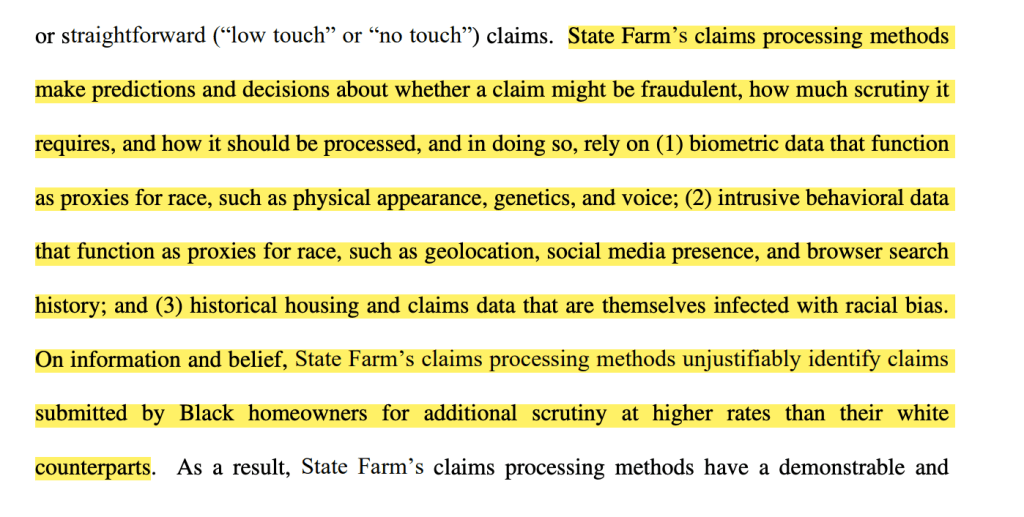
If that sounds too good to be true, it probably is, at least according to one lawsuit that alleges one major insurer used an AI to flag files for fraud based on what amounts to racial dog-whistles. If the allegations are to be believed, the AI works by (basically) assuming claims from policyholders living in poorer, Black-er neighborhoods are more likely to be fraudulent.

According to the lawsuit, which cites a study of 800 policyholders in the Midwest, the AI flags claims as potentially fraudulent based on a host of characteristics that boil down to a proxy for race:

The lawsuit was filed December 14, 2022. No judge or jury has decided if these allegations are true.

But it’s a fascinating look at how practices we think of as tech-industry-focused (using AI in questionable ways) can infect the insurance industry, an industry that is about as “old economy” as it gets.

Summer News Roundup: Bans on Credit Scoring, Bertha the Tunnel Machine, Bargains for Arbitration in ERISA Plans, and Benefit Managers

Courts had a busy summer on insurance and ERISA issues.

A Washington State judge struck down the Washington Insurance Commissioner’s ban on using credit scores to price insurance. The judge acknowledged that using credit scores (which are a proxy for poverty) has a discriminatory impact. Insureds with low credit scores pay more for insurance even if they present a low risk to the insurer. But the judge found that the legislature, not the Insurance Commissioner, has the authority to ban the practice.

The Washington Supreme Court held that there was no insurance coverage for damage to the machine used to bore the tunnel for the replacement of the Alaskan Way Viaduct in Seattle (affectionately nicknamed “Bertha” after Seattle’s former mayor). The machine broke down during the project in 2013. It was determined the machine suffered from a design defect. The Supreme Court held that the design defect fell within the scope of an exclusion in the applicable insurance policy for “machinery breakdown.”

Employers asked the U.S. Supreme Court to rule that ERISA disputes should go to arbitration. Several courts have decided that certain types of lawsuits alleging violations of ERISA’s fiduciary duties cannot be forced into arbitration. The reason is that the plaintiff in these cases sues on behalf of the governing employee benefit plan. ERISA treats such a plan as a separate legal entity. Therefore, an individual employee’s signature on an employment contract with an arbitration clause in the fine print does not bar that employee from suing on behalf of the ERISA plan–at least according to these courts. If the Supreme Court steps in, that could change.

The Supreme Court declined to revisit a case holding that ERISA allows health plans to pay high prescription drug prices. The plaintiffs argued that their health plan’s administrator (called a Pharmacy Benefit Manager) acted as a fiduciary under ERISA when it set the prices the health plan and its participating employees paid for prescription drugs. As an ERISA fiduciary, the administrator would have an obligation to act in the best interest of the participating employees when setting drug prices. The Supreme Court’s decision not to take up the case leaves in place the lower court’s ruling that these administrators were not subject to ERISA’s fiduciary duties.

Insurers Still Breaking Mental Health Coverage Rules Says Department of Labor

The 2022 report to Congress from the Department of Labor (DoL) on compliance by group health plans with the federal mental health parity laws identifies numerous instances of continued discrimination in coverage for treatment of mental health diagnoses.

Federal law generally prohibits insurers from discriminating against people who need coverage for treatment of mental health conditions. Basically, health insurers cannot have limitations that are more restrictive of treatment for a mental health condition than for other conditions. These rules have only become more important since the COVID-19 pandemic contributed to mental health issues for many Americans; for instance, the CDC noted a 30% increase of overdose deaths since the pandemic.

In large part for this reason, DoL has made enforcement of the mental health parity rules a priority in recent years. One new enforcement tool is a 2021 rule passed by Congress requiring health plans to provide DoL with a comparative analysis of treatment limitations for mental health conditions to help DoL ensure these practices follow the law.

DoL’s report identified many problems with health plans’ reporting about mental health parity. For instance:

  • Failure to document comparisons of treatment limitations for mental health limitations before implementing those limitations;
  • Lack of evidence or explanation for their assertions; and
  • Failure to identify the specific benefits affected by mental health limitations.

DoL also noted that enforcing these reporting rules had led to the removal of several widespread insurer practices that violated the mental health parity rules.

For example, one major insurer was found to routinely deny certain behavioral health treatment for children with Autism Spectrum Disorder. This resulted in denying early intervention that could have lifelong results for autistic children. DoL found over 18,000 insureds affected by this exclusion.

Another example involved the systemic denial of treatment used in combatting the opioid epidemic. New research has found that combining therapy with medication can be more effective for treating opioid addiction than medication alone. DoL found a large health plan excluded coverage for this therapy in violation of the mental health parity rules.

Other treatments DoL’s report identified as being denied on a widespread basis in violation of the law included counseling to treat eating disorders, drug testing to treat addiction, and burdensome pre-certification requirements for mental health benefits.

DoL’s report is a reminder that discrimination on the basis of mental health related disabilities remains a part of the insurance business despite years of federal legislation to the contrary.

Department of Labor Sues United Healthcare for Violating ERISA and Mental Health Parity Law

The federal Department of Labor (DoL) has sued UnitedHealthCare for alleged discrimination against patients seeking mental health treatment. DoL contends that UnitedHealthCare, one of the country’s largest health insurers, systematically imposes illegal limitations on coverage for mental health and substance abuse disorder treatment. The August 11, 2021 lawsuit alleges these practices violate ERISA. DoL also asserts UnitedHealthCare is violating the Mental Health Parity Act, a federal law prohibiting discrimination against people with mental health conditions:

Basically, DoL alleges UnitedHealthCare did this in two different ways: (1) paying less for out-of-network mental health treatment than it pays for out-of-network medical and surgical care; and (2) singling out mental health treatment for a special “review program” that limited these benefits in a way that was not applied to similar non-mental health treatment. This is alleged to have happened as far back as 2013.

This isn’t the first time UnitedHealthCare has found itself in court over mental health coverage. A prior lawsuit by made similar allegations, resulting in a ruling that the insurance company had illegally discriminated against mental health patients through secret internal guidelines making it harder to access mental health treatment in order to boost corporate profits.

But the fact that these practices have drawn the ire of federal regulators is significant. DoL is charged with enforcing violations of ERISA. But most federal regulators lack the resources to pursue any but the worst and most systemic violations. DoL’s choice to pursue this particular suit suggests the agency considers these practices to be especially egregious, particularly given the company has already been sued by private insureds.

Hopefully, this signals a pattern of more proactive ERISA enforcement by regulators.